Here is the reflection assignment that helped me with brainstorming:
I used the document and elaborated it more.
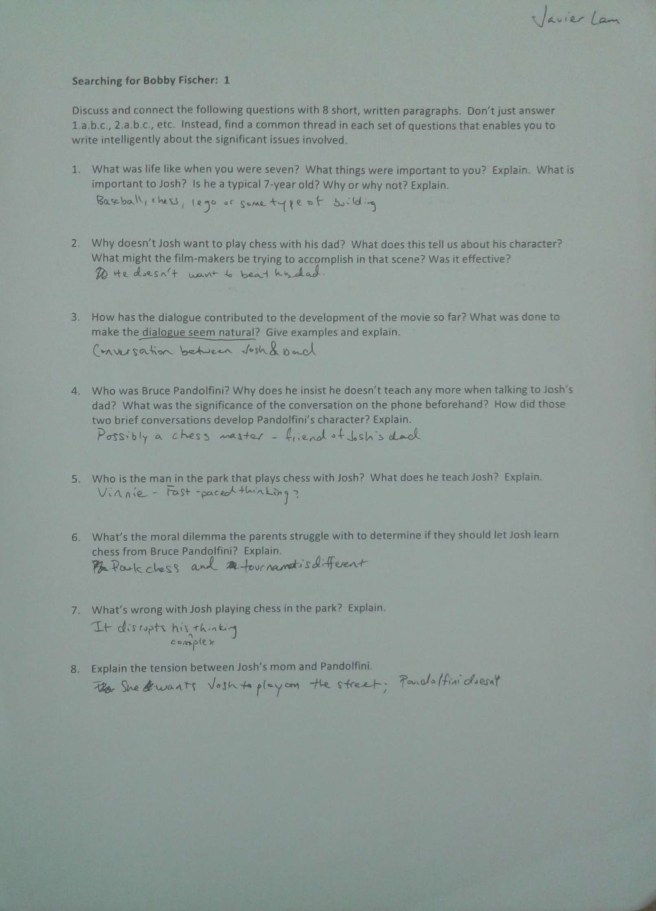
Searching for Bobby Fischer: 1
Discuss and connect the following questions with 8 short, written paragraphs. Don’t just answer 1.a.b.c., 2.a.b.c., etc. Instead, find a common thread in each set of questions that enables you to write intelligently about the significant issues involved.
- What was life like when you were seven? What things were important to you? What is important to Josh? Is he a typical 7-year old? Why or why not? Explain.
When I was seven, I played a lot of Lego and board games, such as Monopoly. Those were both important to me, because I like to think creatively on how to build up something step by step. These ultimately ended up affecting me because I developed my creative mind through this process. Similar to me, Josh loved board games, especially Chess. He also loved sports, such as baseball, which I was not a big fan of it. I think he is a typical seven year old, but the way he approaches it does not seem like a seven year old child. He thinks very logically, step by step, in complex manner, which most seven year old children cannot do.
- Why doesn’t Josh want to play chess with his dad? What does this tell us about his character? What might the film-makers be trying to accomplish in that scene? Was it effective?
Josh does not want to play chess with his dad because he is afraid to disappoint him. This tells us that he respects other people. I personally think that this message from the filmmakers is a bit subtle, and it was not too effective because it is contradictory to what most children do. However, I do understand it quite well.
- How has the dialogue contributed to the development of the movie so far? What was done to make the dialogue seem natural? Give examples and explain.
Dialogue in the movie seemed as a great way to express messages through interaction. For example, when Vinnie and Josh were talking about chess, some chess rules were stated. It seemed natural because they were having eye contact and emotion in it. It also seemed that they were trying to speak to us as if we were one of the characters, making it effective.
- Who was Bruce Pandolfini? Why does he insist he doesn’t teach any more when talking to Josh’s dad? What was the significance of the conversation on the phone beforehand? How did those two brief conversations develop Pandolfini’s character? Explain.
Bruce Pandolfini was one of the great chess players who studied Bobby Fischer’s game. At first, he did not want to teach because he retired from the game after Bobby Fischer disappeared.
- Who is the man in the park that plays chess with Josh? What does he teach Josh?
Vinnie played chess with Josh in the park. In the process, he taught Josh about bringing the queen out, which signifies bringing his best game. He also taught Josh about mentality – to not lose, rather than win. These are both contradictory – one is aggressive, while the other is passive. But the main takeaway is to not lose and play with wise choices.
- What’s the moral dilemma the parents struggle with to determine if they should let Josh learn chess from Bruce Pandolfini?
They don’t want Bruce to mess up his learning by constraining him, because Bruce is limiting his choices of playing chess. He only wants him to play chess that is “real”, which limits his creativity. His parents don’t want him to suffer because of constraints.
- What’s wrong with Josh playing chess in the park?
The people playing in the park are playing it wrong, according to Bruce. They are playing fast paced chess, without complex thinking, and mainly based on luck to see who made the wrong move. That irritates his thinking, because Bruce wants him to think maturely, one step at a time.
- Explain the tension between Josh’s mom and Pandolfini.
Josh’s mom does not want Bruce to control what their family is doing. When Bruce requested to restrict Josh from playing, his mom wanted him to go there to practice and interact with the players there. Another instance was when Josh wanted to see his Master Chess Certificate. Bruce insisted that points did not matter, but the practical use of chess. However, Josh’s mom did not think about that, and forced Bruce out of their home.
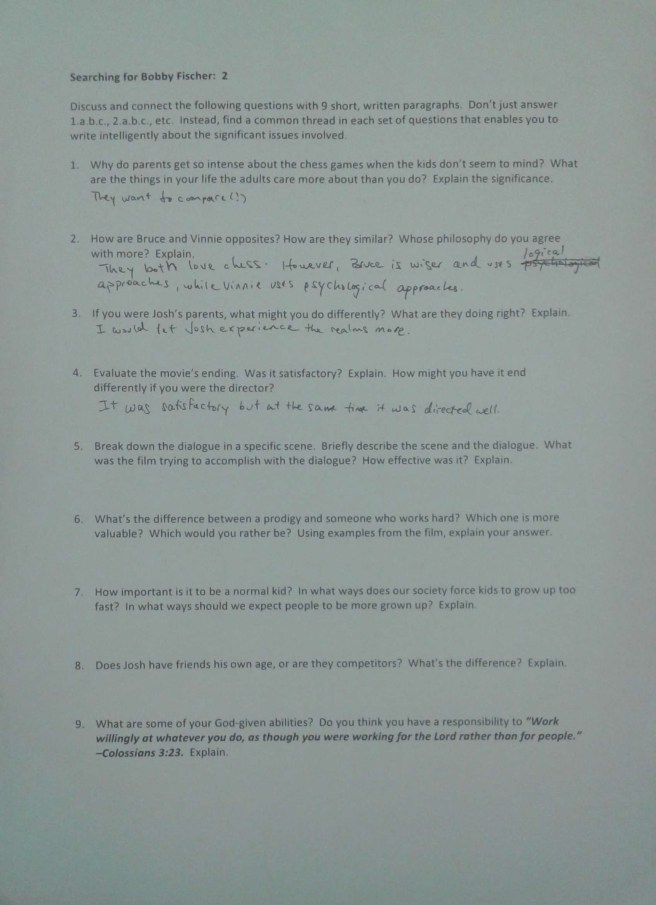
Searching for Bobby Fischer: 2
- Why do parents get so intense about the chess games when the kids don’t seem to mind? What are the things in your life the adults care more about than you do? Explain the significance.
Parents want their children to do their best. As of Josh’s case, his parents want him to be the top chess player. Sometimes, parents care about our future than we do. Like Josh, if he becomes a professional chess player, he will have a good life, which is what parents want to see.
- How are Bruce and Vinnie opposites? How are they similar? Whose philosophy do you agree with more?
Bruce uses a logical, well thought out, slow paced way of playing chess, while Vinnie uses a psychological, fast paced, based on incentive way to play chess. I personally play more like Vinnie, but I agree with Bruce more because that is how we should view anything. We shouldn’t rush to make a move or put pressure, but think about it with great thought.
- If you were Josh’s parents, what might you do differently? What are they doing right?
If I was Josh’s parent, I would not do anything differently because I want my children to learn more from the outside world. That is why I think Josh’s parents are doing the correct way, because Josh was learning from different sources. By learning from different people, he will have multiple perspectives and ways to tackle a problem, not just one.
- Evaluate the movie’s ending. Was it satisfactory? How might you have it end differently if you were the director?
The movie ending was great. I think it satisfies most audiences because we wanted the protagonist, Josh, to win the game. Another common ending, where they draw, could be possible, but not the best choice. I don’t think I would end it differently. Unless if there is a choice, I would leave it as a cliffhanger, just to leave the excitement there.
- Break down the dialogue in a specific scene. Briefly describe the scene and the dialogue. What was the film trying to accomplish with the dialogue? How effective was it?
The dialogue between Josh and his father displayed their relationship between them. With this dialogue, the filmmaker wanted to discuss family relationships, and how a parent should treat their children. It was pretty effective, because they did bring out the main issue, and used dialogue to discuss it.
- What’s the difference between a prodigy and someone who works hard? Which one is more valuable? Which would you rather be? Using examples from the film, explain your answer.
A prodigy is a person with a special talent. I think I am more of a prodigy because I don’t try 100 percent for everything unless I need to. I think that a person who works hard is more valuable, because those people can develop their own talents through practice. I’d rather be a person who works hard because I want to create my own talent. Josh is a prodigy because he is not only talented in chess, but he knows how to play good baseball and has his own perception towards life.
- How important is it to be a normal kid? In what ways does our society force kids to grow up too fast? In what ways should we expect people to be more grown up?
It should not be a normal or abnormal thing, but rather let a kid be who they are. What makes children “normal” is the standard of society. If a parent forces a child to go to many extracurricular activities in a society where children are competitive, then it sets the standard for a child
- Does Josh have friends his own age, or are they competitors? What’s the difference?
Josh has both friends and competitors at his own age. He views all competitors as friends, because he respects them. He also has friends that are not his age, such as Vinnie and Bruce. A friend and a competitor both make you stronger, and they make Josh stronger in the same way.
- What are some of your God-given abilities? Do you think you have a responsibility to “Work willingly at whatever you do, as though you were working for the Lord rather than for people.” –Colossians 3:23.
I think my God-given abilities include art, math, music, and some Christian virtues. However, I don’t think I work willingly, because I usually have a motivation behind what I do. Without the motivation, I do not do it willingly. I feel that I am working for people rather than the Lord, because I want to please others. However, most of what I do also pleases the Lord, so it works either way.
This was an in-class essay that I did not proofread. However, it turned out to be fine.
Searching for Bobby Fischer Essay – Javier Lam
Bruce Pandolfini was the character that stood out to me in the movie. His mirror, Sir Alex Ferguson, a legendary football manager and coach, was similar to him in several different ways. Both of them were wise teachers, studied the game relentlessly for experience, and loved to coach young players that could become the next generation’s stars.
First of all, both Bruce Pandolfini and Sir Alex Ferguson are both wise teachers. Both of them were calm when teaching, yet they were extremely expressive when they watched games. When Bruce was teaching Josh Waitzkin at Josh’s home, he was not angry, even if Josh made silly mistakes. Sir Alex did the same during his training sessions. He just stood there and looked at the players, and told his assistants to give instructions. However, during the final game between Josh and Jonathan, Bruce was furious when Josh moved his queen earlier than expected. Sir Alex was also stern during important matches. When clear fouls were not given by the referee, he complained to the fourth official of the match. They both had instincts that told them what was wrong and what was the best solution, which made them wise teachers of their respective fields.
Second, both wise teachers had large amounts of experience through studying games. Bruce, as described as one of the most experienced Chess teachers, studied Bobby Fischer’s games, and analyzed them so he could teach Josh every single move. He also studied other Chess players’ games in local tournaments, which gave him extra knowledge to teach Josh. On the other hand, Sir Alex studied football since he was a player, in the early Sixties. He continued to study games for approximately fifty years, and taught his players the best playing style against different opponents. Both of their experience led to giving the best to their pupils.
Third, both coaches loved to develop young players, and were exceptional at knowing the players’ strengths and weaknesses. Bruce developed Josh when he was around seven years old, knowing his potential to be one of the top players of his age. He knew Josh’s strengths, such as maneuvering pawns to combine for an attack, as described in the movie. He also knew his weaknesses, like bringing out the queen early, and told him not to do that. Sir Alex also knew his players well, but instead of one-on-one tutoring, he taught the youth players as a group. He developed some of the world’s best modern footballers, such as the Class of 92, including David Beckham, Ryan Giggs, and Paul Scholes. He knew when to use which player, like Scholes for control in midfield, and knew when players were not playing well. Both of them taught young players as if they were his children.
In their respective positions, Bruce Pandolfini and Sir Alex Ferguson were wise, had huge amounts of experience from studying games, and loved to develop young players. They were mirrors of each other, as they were among the best teachers of their respective field in their generations, who brought wisdom and knowledge to their pupils.
Teacher comment:
Not sure that “mirrors of each other” is the best way to describe them, but you’ve done a nice job of comparing these two coaches. Clear and straightforward, but maybe lacking in depth of analysis.
H
 Javier Lam Writer's Blog